ProductionCompass AI powers production optimisation in aquaculture
Quick information
- Available
- Americas, Europe, Asia, Africa and Oceania
- TechnologyArtificial intelligence and machine learning


At a glance
- Turns multi‑source biological data into real-time growth forecasts and decision support for aquaculture
- Improves production outcomes, lowers mortality and reduces resource use
- Scales across seafood species, facilities and other biological production such as forestry and agriculture
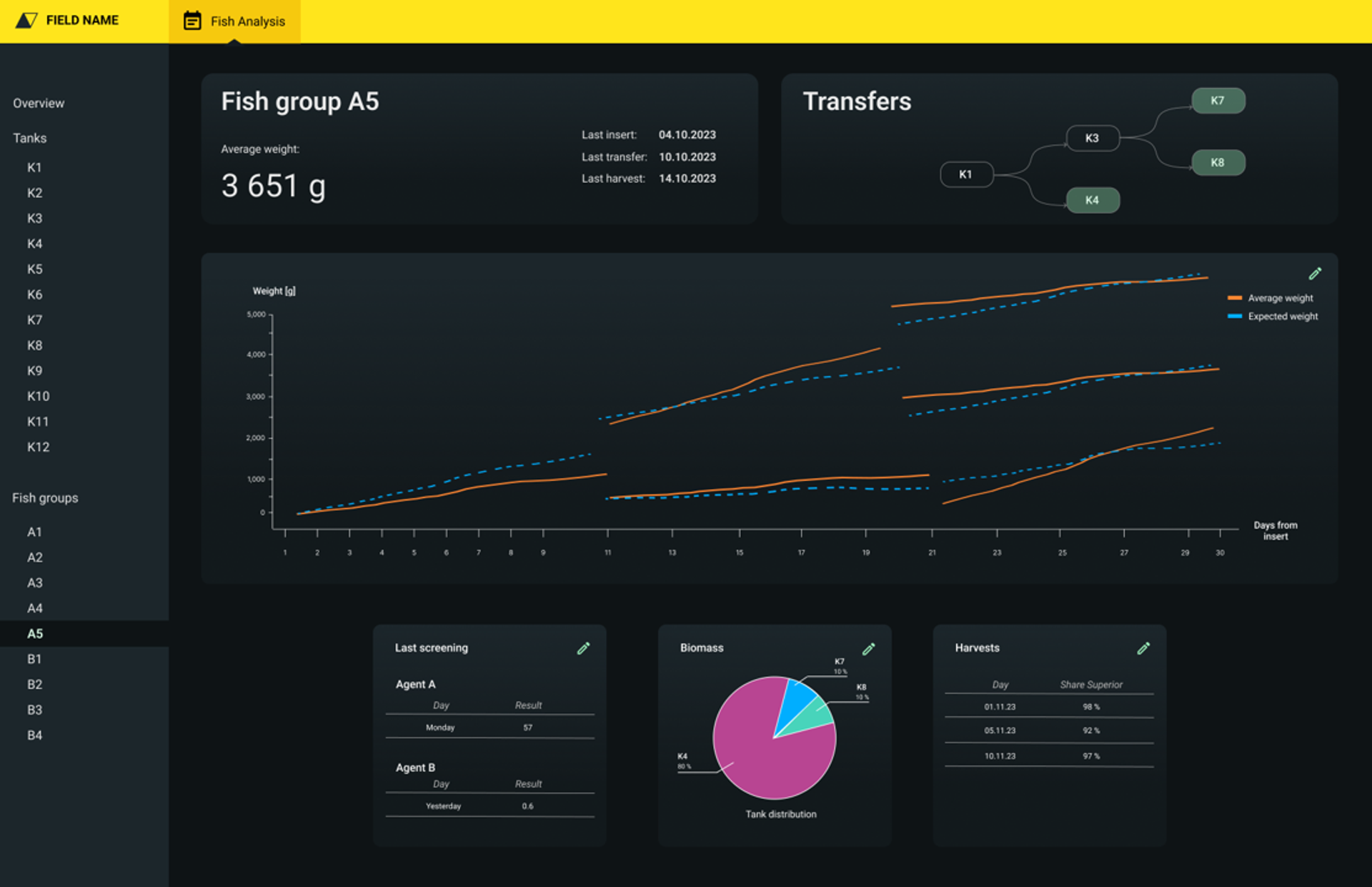
Aquaculture and other biological production is becoming increasingly data-rich, but production decisions are still often guided by simplified growth models. ProductionCompass AI closes this gap by combining sensor, camera and operational data to forecast biomass growth in real time and flag anomalies early.
CHALLENGE
Traditional growth models fall short in biological production
Biological production systems generate vast amounts of data, yet much of it remains underused. Traditional growth models are often simple, utilising only a fraction of available data and failing to account for the complexity and uncertainty of biological processes. This leads to significant variability in performance across batches and harvests, inefficient resource use and inconsistent product quality.
SOLUTION
ProductionCompass AI: from raw data to real‑time decisions in aquaculture
ProductionCompass AI is an AI‑powered production optimisation solution built on Solution Seeker’s proprietary Squashy framework for data mining and NeuralCompass for transfer learning.
The solution is relevant for all types of aquaculture, but is particularly powerful for land-based seafood farming and other closed systems with many sensor data streams. ProductionCompass AI integrates data from tank sensors, cameras and operational reports to predict biomass growth in real time. This enables:
- Real-time production planning by optimising feeding rates, stocking density and water quality
- Early anomaly detection by identifying stress or signs of disease before mass losses occur
- Scalability by applying models across different facilities and species, including salmon, grouper, shrimp and yellowtail kingfish, through advanced transfer learning models
BENEFITS
Higher yields with a lighter environmental footprint
For seafood farmers, ProductionCompass AI reduces variability between production batches, lowers mortality rates and improves fish welfare, which can lead to significantly increased production throughput without increasing input factors – for instance from a better price point achievement through more accurate market matching.
The solution minimises waste of critical resources such as feed, oxygen and water. It enables critical production gains from costly land-based seafood farms, prevents disease transmission associated with sea-based systems and alleviates pressure on overburdened marine and coastal ecosystems.
Moreover, Solution Seeker has generalised its core technology to tackle diverse “low-data problems”, from flow rates in oil wells to biomass growth and carbon sequestration in forestry. The company is currently conducting pilots to model carbon sequestration in native forests in Brazil as well as biomass growth in precision agriculture based on all available data parameters.
MARKET POTENTIAL
Rapidly growing market for AI-based optimisation of biological production
The market for AI-based optimisation in aquaculture is expanding rapidly alongside the global push to scale sustainable seafood production. According to a 2020 study published in Nature, the sustainable supply of ocean-derived food alone is projected to increase by over 50 per cent compared to current yields and reach 80 million metric tons by 2050.
However, as ocean ecosystems face ecological and spatial constraints, intensive land-based aquaculture is experiencing aggressive growth to help meet the surging global demand for aquatic protein. Highlighting this shift, a 2024 report by Boston Consulting Group (BCG) projects that land-based Atlantic salmon production alone will increase from approximately 23 000 metric tons in 2024 to roughly 190 000 metric tons by 2030.
Given that land-based facilities must manage highly complex biological environments, scaling them effectively relies on turning massive, fragmented data streams into actionable insights - creating a vast and immediate need for intelligent optimisation tools.

Advancing the Sustainable Development Goals