C-RAY: Efficient removal of biofouling from subsea infrastructure
Quick information
- Available
- Europe and Asia


At a glance
- ROV based system for mechanical cleaning using high pressure water and rotating discs
- Biofouling is removed on site, reducing vessel use, costs and environmental impact
- Suitable for use during operation, lifetime extension and decommissioning
Maintaining underwater infrastructure is becoming more complex as assets age and environmental requirements tighten. Bravo Marine has developed the C-RAY® ROV solution to make subsea cleaning safer, faster and more sustainable.
CHALLENGE
Keeping subsea structures clean without high cost or environmental impact
Biofouling accumulates on wind turbines, offshore installations, vessels and other subsea structures throughout their operational lifetime. Traditional cleaning methods rely on divers or work‑class ROVs, which are costly, time‑consuming and resource‑intensive.
In lifetime extension and decommissioning projects in the offshore sector, the need to remove marine growth efficiently, while limiting vessel use and emissions, is increasing.
SOLUTION
A specialised ROV‑based system for gentle, high‑performance cleaning
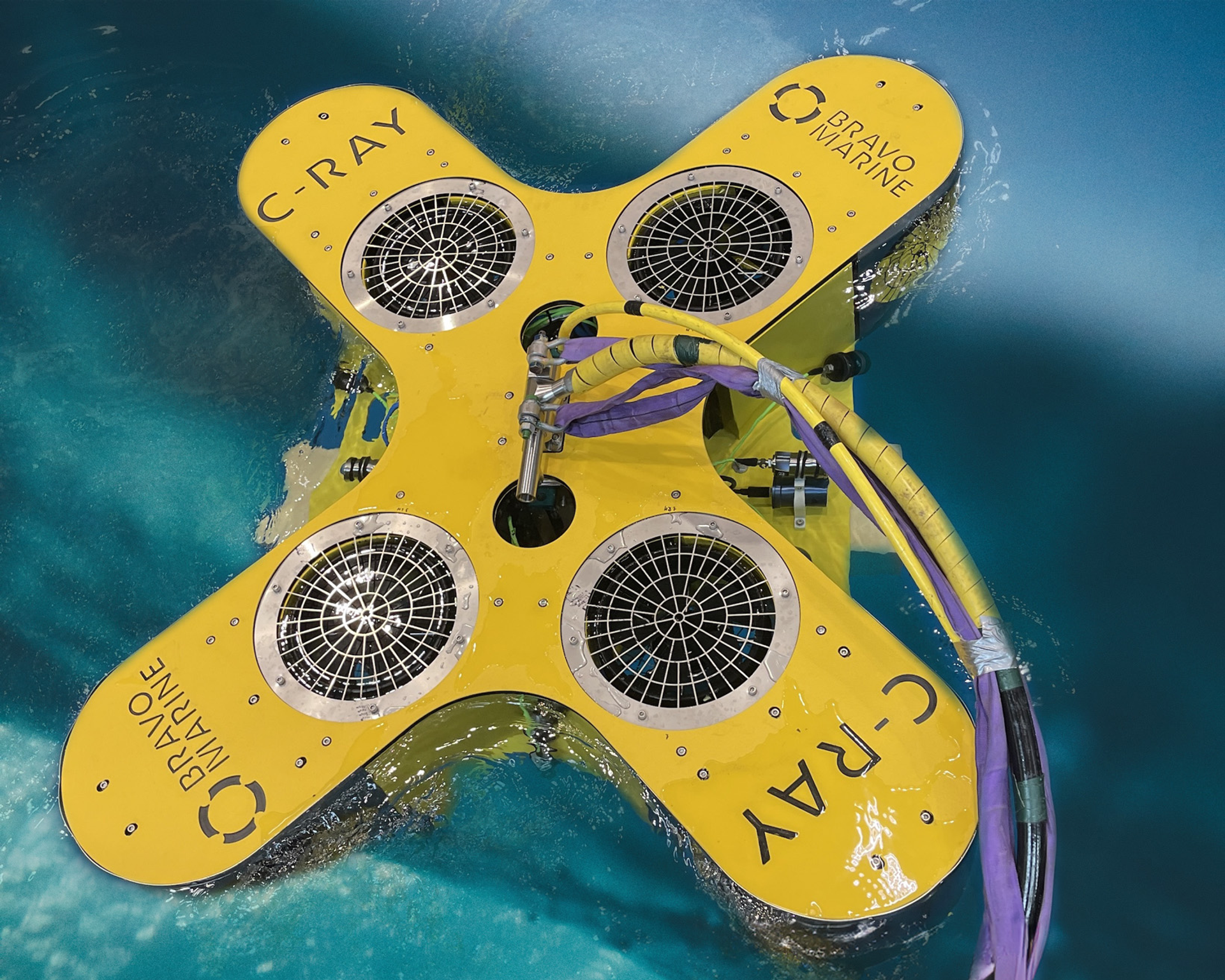
Bravo Marine’s C-RAY® ROV is a patented underwater cleaning system for removing marine growth from all types of submerged structures. The cleaning module is mounted on a specially designed ROV platform and combines high‑pressure water jets with rotating cleaning discs. C-RAY® automatically adjusts to the structure against which it is placed, enabling effective mechanical cleaning of pipes and flat surfaces without modification to the system.
C-RAY® can be deployed from vessels or offshore installations and operates at depths of up to 300 metres. Its optimised shape allows access to hard‑to‑reach areas, including corners and subsea equipment, while a proprietary lance enables near‑complete cleaning efficiency.
BENEFITS
C-RAY for efficient cleaning, safer operations and less environmental impact
C-RAY® removes all types of marine growth in all types of environments, from European to tropical waters, gently and efficiently.
Cleaning is performed on site, eliminating the need to move structures. This reduces vessel use, lowers CO₂ emissions and limits the spread of marine growth, minimising operational footprint and delivering significant cost savings.
C-RAY® also has a dual function. When not equipped with the cleaning module, the ROV can serve as a standard observation tool for inspection of submerged infrastructure.
MARKET POTENTIAL
Strong demand driven by global offshore decommissioning
The global market for subsea cleaning and decommissioning services is growing rapidly, estimated at USD 8–9 billion in 2025 and projected to reach USD 16–17 billion by 2034.
Europe represents around half of the global market, dominated by Norway and the UK in the North Sea. Asia is the fastest‑growing region, with some 1 500 platforms in countries such as Indonesia, Malaysia and Thailand entering the decommissioning phase. Australia is emerging as a future hotspot due to ageing offshore assets.