

Norway is leading the way in greener cruising
Published 6 Dec 2022 (updated 20 Oct 2026) · 4 min read
Did you know that Norway’s World Heritage fjords are already changing the way passenger ships operate?
In the Geirangerfjord and Nærøyfjord, new zero-emission requirements are already in force for smaller cruise ships, while larger vessels face a later deadline.
For tourists, the promise is a serene encounter with extraordinary landscapes.
For cruise operators, shipowners and destinations, the question is more complex: how can cleaner sailing work across different vessel sizes, routes and operating conditions?
Protecting Norway’s World Heritage fjords
Norway’s fjords are the country’s biggest tourist attraction. Geirangerfjord, for example, receives around 700 000 visitors in the summer months alone, most of whom arrive by cruise ship.
The Norwegian Government has taken concrete steps to protect Norway’s World Heritage Fjords. Since 1 January 2026, passenger ships below 10 000 gross tonnage entering the Geirangerfjord and Nærøyfjord have had to operate using energy sources that produce no direct carbon dioxide or methane emissions. The same requirement will apply to ships of 10 000 gross tonnage and above from 1 January 2032. Cruise operators must also connect vessels to shore power where available. The requirements apply both to ships operating within the fjords and to those passing through them.
The regulation is technology neutral. It sets the operating requirement without prescribing a single energy solution. That leaves room for different approaches, depending on a vessel’s size, route and purpose.
Developing cleaner cruise ships
The challenges differ from ship to ship. How can an existing coastal vessel use less fuel? What does a passenger ship need to sail without direct emissions in a fjord? And how can new technology improve the visitor experience, while complying with a requirement?
The Norwegian cruise operators Hurtigruten, Havila Voyages and Brim Explorer are taking three different approaches.


Hurtigruten: improving today’s fleet and creating tomorrow’s
Hurtigruten, one of Norway’s main coastal cruise operators, is pursuing two parallel paths towards lower-emission operations. The first focuses on improving vessels already in service.
As of 2026, the company has installed hybrid systems on four vessels alongside a full engine replacement on a fifth. Moreover, all vessels can now operate on certified biofuels (HVO/MGO blends) and connect to shore power where available.
Hurtigruten is also exploring what the emission-free passenger ship of tomorrow could look like. Since 2022, the company has led Sea Zero, an R&D project that brings together leading players from Norway’s maritime sector. In spring 2026, the project concluded that it is possible to design a vessel capable of operating the Bergen-Kirkenes route without direct emissions during normal service, using batteries as its primary energy source.
“Sea Zero shows that emission-free operation of larger passenger ships is no longer just a vision but a realistic goal under the assumptions applied in the project. The knowledge and solutions developed through the project can contribute to the transformation of the entire maritime industry.”
Hedda Felin
CEO of Hurtigruten
According to the final report, Sea Zero can reduce energy consumption by 44 per cent through a combination of innovations, making battery-powered operation significantly more feasible.
Among the technologies tested are retractable wind and solar sails, contra-rotating propellers, air lubrication systems that allow the vessel to move more efficiently through the water, and smarter heating and ventilation systems.
Researchers have conducted extensive digital simulations and physical testing, including trials with an eight-metre model in SINTEF’s laboratories in Trondheim. Results show that the vessel design, sails and propulsion systems could deliver substantial energy savings in practice.

Challenges remain. The concept is based on a 73 MWh battery system and would require access to sufficient charging infrastructure along the Norwegian coast.
“It is possible to charge quickly enough in ports and have batteries large enough to sail the entire Bergen-Kirkenes route without emissions,” says Gerry Larsson-Fedde, Chief Operating Officer at Hurtigruten. “However, this will require access to electricity in selected ports, and charging infrastructure is the biggest challenge to actually putting such a ship into operation.”
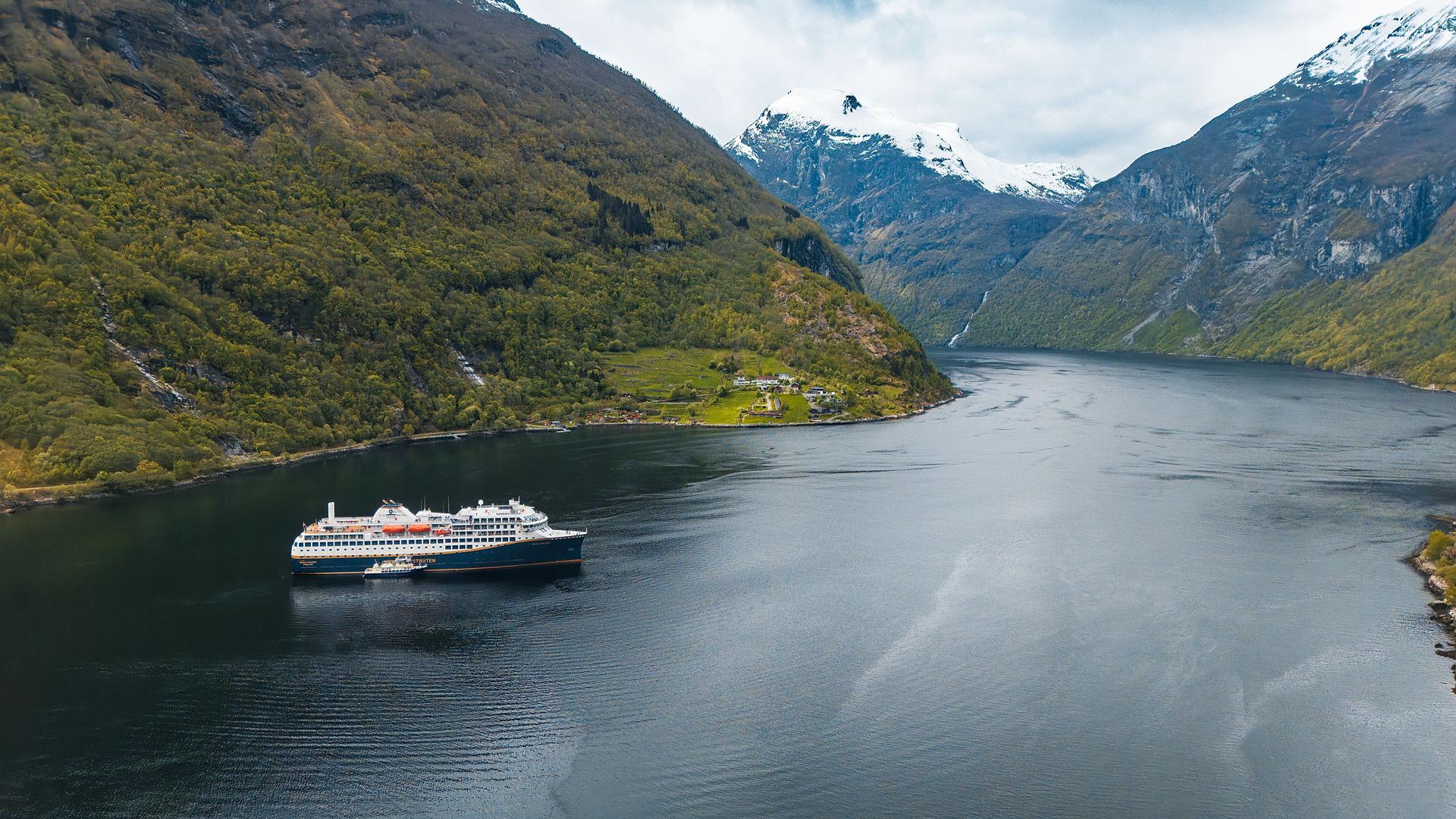
Havila Voyages: charting a course towards zero emissions
Havila Voyages is also one of Norway’s main coastal cruise operators and it, too, is exploring how coastal cruising can be made more sustainable, but through a different technological pathway.
The company operates four hybrid coastal cruise ships powered by a combination of liquefied natural gas (LNG) and batteries.
Equipped with some of the largest battery packs installed on passenger ships, the vessels can sail for up to four hours without emissions. This allows passengers to experience some of Norway’s most environmentally sensitive nature with minimal impact and almost complete silence.
The batteries can also be charged in port using electricity generated from Norwegian hydropower.
For Havila Voyages, the transition to zero-emission operations is being approached step by step. LNG is widely regarded as an important “bridging fuel” as the maritime industry develops commercially viable low and zero-emission alternatives at scale. To prepare for the next phase of the transition, the vessels have been designed for conversion to hydrogen, once it is approved and accessible for passenger vessels.
In the meantime, the company is focusing on reducing emissions with the technologies available today.
“In the short term, we will gradually blend liquefied biogas with the natural gas we use today. Biogas has the same properties as the natural gas. We aim to be fully operational using only biogas by 2028, thus becoming carbon neutral.”
Bent Martini
CEO of Havila Voyages
“After that, we will switch to emission-free fuel alternatives such as hydrogen, and the goal is zero emissions by 2030,” he adds.
The path to greener cruising involves more than fuel choice. Havila also invests in energy optimisation, such as its energy recovery system, which captures excess heat generated on board and uses it to charge the ships’ batteries, helping reduce fuel consumption and improve overall efficiency.
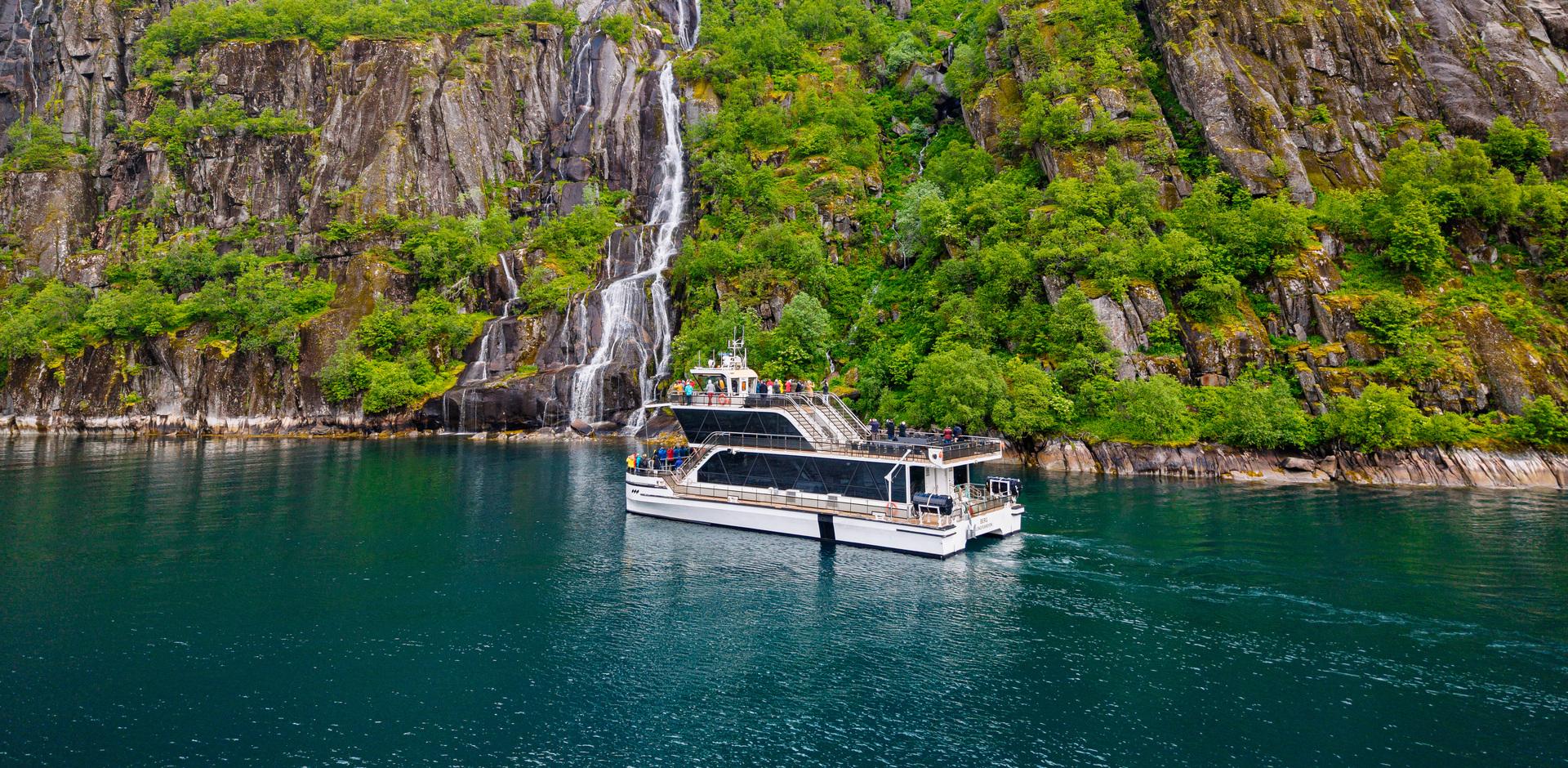
Brim Explorer: bringing tourists closer to nature with electric boats
Brim Explorer operates on a smaller scale, designing, building and operating purpose-built electric and hybrid-electric passenger vessels.
With silent engines and panoramic windows, these smaller boats come closer to nature,
using cameras, microphones and underwater drones to show guests life above and below the water.
The company’s approach demonstrates that sustainability can be a competitive advantage, not just a compliance requirement. With electric engines that eliminate emissions and noise pollution, reduce disturbance to wildlife and enhance the guest experience, Brim Explorer is attracting a growing group of environmentally conscious travellers.
“Our goal was to prove that it makes financial sense to prioritise sustainability. Over time, it has become increasingly clear that more and more tourists are concerned about their impact on the environment and are choosing the greenest option.”
Agnes Árnadóttir
CEO of Brim Explorer
Brim Explorer continues to expand both in Oslo and Arctic destinations such as Lofoten and Tromsø, reflecting rising demand for sustainable experiences in stunning fjord landscapes and close to wildlife. Growth is being driven by increasing interest from both Norwegian and international travellers.
Brim Explorer currently has five boats in operation in Norway. It is also building two fully electric, high-speed trimarans, which will be some of the world’s most efficient battery-powered passenger vessels when completed. The vessels are being designed for 180 passengers, a cruising speed of 20 knots and a range of 100 nautical miles.